
Table of Contents
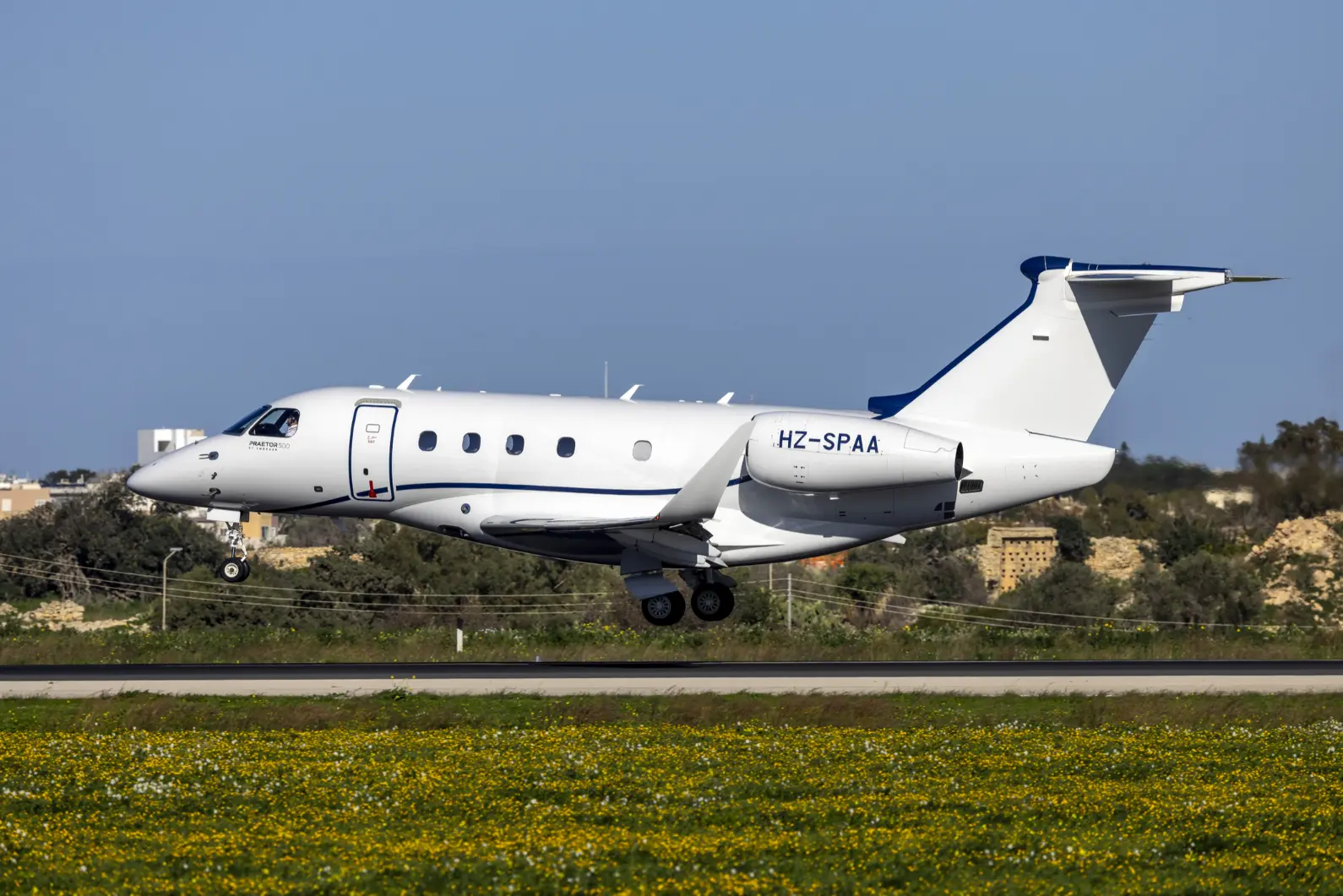
A Transitional Super-Midsize Jet That Rewards Precision
The Praetor 500 is often viewed as a more approachable alternative to the larger Praetor 600—offering extended capability without fully committing to the upper end of the super-midsize category. In practice, it occupies a narrower and more deliberate space.
Rather than being a scaled-down version of the 600, the Praetor 500 is best understood as a precision aircraft. It is designed for owners whose missions have expanded beyond light jet limits but who remain disciplined about how far they intend to go.
Evaluating the Praetor 500 correctly requires resisting the urge to treat it as a compromise. It performs best when selected intentionally for defined missions, not when chosen as a hedge between categories.
How the Praetor 500 Fits Within the Embraer Lineup
Within Embraer’s lineup, the Praetor 500 sits between the Phenom 300 and the Praetor 600—but its role is not simply to bridge the two. It represents a shift into super-midsize ownership without fully embracing the scale, margin, and staffing expectations of the 600.
The Praetor 500 often enters the conversation for buyers moving up from light jets who want extended range and improved comfort, but who do not yet require the full flexibility of the larger aircraft. It can also appeal to owners stepping down from larger jets who are tightening mission scope rather than maintaining maximum reach.
Unlike the Praetor 600, which often serves as a long-term consolidation aircraft, the Praetor 500 tends to be chosen when mission profiles are clear—but not expansive. Its success depends heavily on how stable those missions truly are.
Mission Profile & Real-World Use
The Praetor 500 performs best on longer domestic missions and selective international routes where range and comfort matter more than maximum cabin volume. It is well suited for operations that exceed light jet limits but do not routinely push into long-haul territory.
In real-world use, the aircraft benefits from disciplined planning. Passenger counts, baggage needs, and destination profiles are typically well understood in advance. When used within these parameters, the Praetor 500 feels composed and efficient.
Where friction can arise is when buyers expect the aircraft to absorb frequent mission expansion. While capable, the Praetor 500 has less margin than the 600, and that difference becomes noticeable when variability increases.
Cabin & Passenger Experience
The Praetor 500 cabin offers a clear step up from light jets in comfort and refinement, particularly on longer legs. It provides improved seating, better noise characteristics, and a more accommodating environment for extended travel.
For many owners, the cabin strikes a balance between efficiency and comfort. Passengers experience meaningful improvement without crossing into large-cabin expectations.
That balance, however, is also its constraint. The cabin is not designed to replicate the experience of larger super-midsize or large-cabin aircraft, and satisfaction remains highest when expectations remain grounded in how the aircraft is actually used.
Avionics & Pilot Environment
The Praetor 500 shares much of the systems philosophy found in the 600, emphasizing integration, automation, and workload management as mission complexity increases.
For professional crews, the cockpit supports standardized operation across longer and more demanding missions. For owner-operators, training and procedural discipline become increasingly important, even though owner-flown use is less common at this level.
The pilot environment reflects a transition point: more structure than light jets require, but without the full operational posture demanded by larger aircraft.
Performance & Operational Reality
From a performance standpoint, the Praetor 500 delivers extended range and improved payload capability compared to light jets, but with tighter margins than the Praetor 600.
In real-world operation, owners benefit most when missions align closely with the aircraft’s design envelope. The Praetor 500 performs reliably when used consistently, but tradeoffs emerge more quickly when demands fluctuate.
The aircraft is best evaluated not on peak capability, but on how often its full performance envelope is actually needed.
Ownership & Operating Considerations
Ownership of the Praetor 500 introduces greater formality compared to light jets, including crew expectations, maintenance planning, and operational oversight. However, many owners find the step manageable when mission scope remains stable.
The aircraft tends to appeal to buyers who want increased capability without committing fully to the scale of the Praetor 600. That balance can work well—but only when ownership expectations are realistic.
Buyers who anticipate rapid mission growth or increasing variability may find that the aircraft feels transitional sooner than expected.
Common Buyer Misconceptions
“It’s just a smaller Praetor 600.”
While related, the two aircraft serve different ownership profiles. The 500 requires more precision in mission planning.
“It covers most of what the 600 does.”
In many cases it does—but with less margin. That distinction matters over time.
“It’s a safe middle ground.”
The Praetor 500 rewards clarity, not indecision. Middle-ground thinking often leads to second-guessing.
Most dissatisfaction stems from misjudging how stable missions will remain.
Who the Praetor 500 Is Right For
The Praetor 500 is well suited for owners whose missions have clearly outgrown light jets but do not require maximum super-midsize capability.
It aligns particularly well with:
Principals flying longer domestic missions with consistency
Buyers stepping up deliberately rather than reactively
Owners seeking improved comfort without large-cabin scale
Operations with defined, repeatable trip profiles
It is less compelling for buyers anticipating frequent mission expansion or seeking long-term consolidation.
Advisory Perspective
The Praetor 500 is a precision aircraft. When chosen intentionally, it can be a highly effective solution that balances capability and efficiency. When chosen as a hedge, it often invites reconsideration later.
For buyers who understand their missions clearly and value restraint, the Praetor 500 can fit exceptionally well. For those still exploring how far they want to go, the aircraft may feel like an interim step rather than a destination.
As always, alignment determines satisfaction.